
There are few places in Burgundy where geography tells the story of wine quite so compellingly as Saint-Aubin. Tucked into a valley immediately behind the famous slopes of Puligny-Montrachet and Chassagne-Montrachet, Saint-Aubin sits in the shadow of some of the most celebrated white wines on earth—and yet remains, remarkably, one of the Côte de Beaune’s great discoveries.
Officially, Burgundy’s celebrated “Golden Triangle” is formed by Meursault, Puligny-Montrachet and Chassagne-Montrachet. But Saint-Aubin belongs in the conversation. It is their immediate neighbour, and some of its finest vineyards sit remarkably close to the Grand Crus that have made Burgundy legendary. The region’s official Burgundy wine body describes Saint-Aubin as a close neighbour of Montrachet, between Chassagne and Puligny, with steep slopes, limestone-rich soils and elevations of roughly 300–350 metres.
That proximity matters. We like to think of it as the Golden Rectangle!
Saint-Aubin’s white wines are largely Chardonnay grown in pale, limestone-rich soils. The combination of altitude, exposure, drainage and limestone gives the wines a distinctive energy: fresh, mineral, precise and often remarkably complex. There are 30 Premier Cru climats, an extraordinary concentration for an appellation that still tends to fly beneath the radar of international Burgundy collectors.
And this is where Saint-Aubin becomes particularly fascinating. It is not simply a cheaper alternative to Puligny or Chassagne. The best vineyards have a character of their own, while sharing the same geological neighbourhood as Burgundy’s greatest white-wine sites. Among the most compelling are En Remilly, Les Murgers des Dents de Chien, Les Champlots and La Chatenière—vineyards climbing the slopes towards Puligny and Chassagne. Burgundywine.com notes that several Saint-Aubin Premier Crus actually touch the Montrachets, giving these sites an extraordinary pedigree.
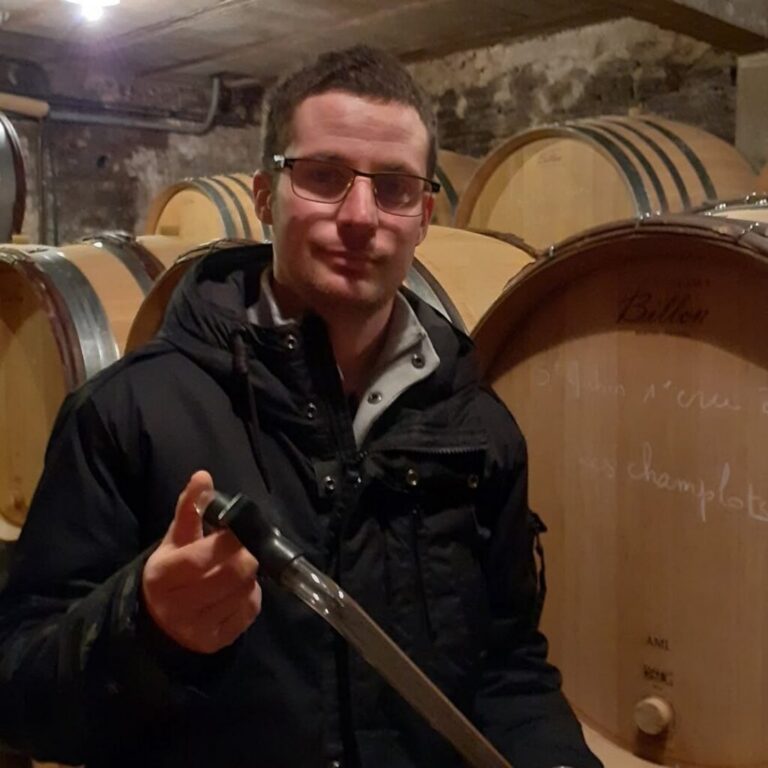
Gilles Bouton: a poster child for Saint-Aubin
If Saint-Aubin needs a producer to make the case, Domaine Gilles Bouton is an obvious candidate.
Bouton is a perfect example of how the appellation can reward those prepared to look beyond Burgundy’s famous labels. Gilles Bouton took over his maternal grandfather’s four-hectare estate in 1977. Today, the domaine covers around 15 hectares across Saint-Aubin, Chassagne-Montrachet, Puligny-Montrachet and Meursault—effectively tracing the heart of the Golden Triangle and its immediate surroundings. His son Julien joined him in 2008.
The story of Bouton’s Saint-Aubin wines is especially compelling. His Premier Cru holdings include En Remilly, Les Champlots, La Chatenière and Les Murgers des Dents de Chien. These are not anonymous parcels chosen simply because Saint-Aubin offers good value; they are some of the appellation’s most distinguished sites.
At burgundywine.com, the first taste of Bouton’s Saint-Aubin 1er Cru “En Remilly” became something of a revelation—a wine with the precision, mineral backbone and complexity to make you question why the bottle beside it costs so much more.
That is really the Saint-Aubin story in miniature.
It is an appellation with the terroir to produce serious Burgundy, positioned almost impossibly close to the great names of the Côte de Beaune, but without the same weight of reputation or price. The result is a fascinating gap between perception and reality.
For the Burgundy drinker, that gap is an opportunity.
Saint-Aubin is where the road from Chassagne to Puligny suddenly becomes more interesting. It is where limestone, altitude and exposure combine to produce whites of energy and finesse. And it is where producers such as Gilles Bouton demonstrate that the next great discovery in Burgundy does not necessarily lie farther down the road—it may be sitting right beside the vineyards you already know.
In a region where the most famous names increasingly command extraordinary prices, Saint-Aubin remains one of the places where the magic of Burgundy can still feel like a secret.