
There are dishes that announce themselves with fireworks, and then there are dishes that simply make everyone gather around the table.
Coq au Vin belongs firmly in the second category.
A great French country classic of chicken slowly braised with red wine, bacon, mushrooms, onions and herbs, Coq au Vin is the kind of food that feels both wonderfully rustic and quietly sophisticated. It is hearty without being heavy, impressive without being fussy, and—perhaps most importantly for the American cook—something you can make ahead and enjoy with a table full of friends.
As we arrive at Labor Day and the unofficial end of summer, that makes Coq au Vin an especially appealing dish. The evenings are beginning to cool, the first signs of autumn are appearing, and we are naturally moving from the grill toward the kitchen. It is a perfect moment to bring a little Burgundy to the table.
A Little History: From Country Cooking to French Classic
The precise origins of Coq au Vin are difficult to pin down. There are charming legends connecting the dish to ancient Gaul and Julius Caesar, but the historical evidence doesn’t really support such an ancient pedigree. What we do know is that cooking older, tougher birds slowly in wine is the sort of practical country cooking that makes perfect culinary sense.
One of the earliest documented versions appeared in the early 20th century, while a related French recipe for chicken cooked in white wine appeared as early as 1864. Burgundy eventually became particularly associated with the dish, and red Burgundy became the classic choice for the pot.
The dish’s great American moment came later.
In 1961, Simone Beck, Louisette Bertholle and Julia Child included Coq au Vin in Mastering the Art of French Cooking. Child subsequently prepared it on The French Chef, helping introduce generations of American home cooks to the idea that French cooking could be accomplished in an ordinary American kitchen.
And perhaps that explains why Coq au Vin has endured. It is French, certainly—but it is also deeply democratic. Chicken, bacon, mushrooms, onions and wine go into one pot, and time does the rest.
Why Coq au Vin Remains So Popular
Classic dishes survive because they continue to make sense.
Coq au Vin has never really gone out of fashion. It appears in French restaurants, cookbooks and home kitchens because it delivers exactly what we want from comfort food: layers of flavor, tender meat and a rich sauce that practically begs for something to soak it up.
There is also something wonderfully adaptable about it. Traditionally, the dish was made with a mature rooster, who’s tougher meat benefited from long, slow cooking. Today, chicken is far more commonly used, making the recipe accessible to the American home cook.
And then there is the wine.
Wine isn’t simply an accompaniment to Coq au Vin. It is part of the architecture of the dish. The acidity, fruit and earthy character of Pinot Noir become woven into the sauce, while the finished wine at the table completes the conversation.
That is precisely where Burgundy shines.
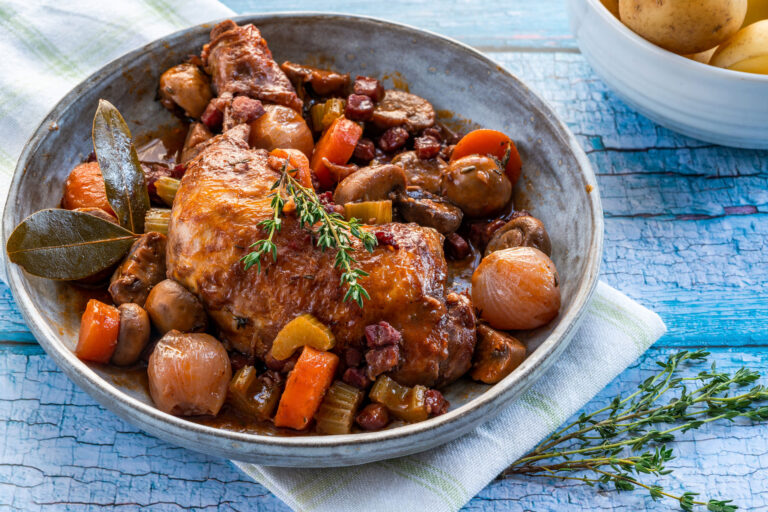
Coq au Vin for the American Kitchen
You don’t need a French farmhouse, a copper casserole or a rooster from Burgundy to make an excellent Coq au Vin.
For an American kitchen, we like bone-in, skin-on chicken thighs and drumsticks. They are forgiving, flavorful and particularly well suited to slow braising. A good-quality bacon stands in beautifully for traditional lardons, and ordinary cremini or white mushrooms work wonderfully.
Most importantly, use a wine you would actually be happy to drink.
At burgundywine.com, we’ve always believed that there is no such thing as “cooking wine.” A good Burgundy brings far more to the pot than alcohol: fruit, acidity, structure and the unmistakable character of Pinot Noir. This is exactly the philosophy we apply to Burgundy cooking more generally.
Coq au Vin
Serves 6
Ingredients
- 4½ to 5 pounds bone-in, skin-on chicken thighs and drumsticks
- 6 ounces thick-cut bacon, cut into ½-inch pieces
- 1 large yellow onion, diced
- 2 carrots, peeled and sliced
- 4 garlic cloves, finely chopped
- 2 tablespoons all-purpose flour
- 3 cups good-quality red Burgundy
- 1½ cups chicken stock
- 8 ounces cremini or button mushrooms, quartered
- 12 ounces pearl onions, peeled
- 2 tablespoons tomato paste
- 4–5 sprigs fresh thyme
- 2 bay leaves
- 2 tablespoons unsalted butter
- 2 tablespoons olive oil
- Salt and freshly ground black pepper
- Chopped fresh parsley, for serving
Method
1. Brown the chicken.
Pat the chicken thoroughly dry and season generously with salt and pepper.
Heat a large Dutch oven over medium heat. Add the bacon and cook until it has rendered its fat and become crisp. Remove the bacon with a slotted spoon and set aside.
Working in batches, brown the chicken in the bacon fat, adding a little olive oil if necessary. Don’t rush this step. You want deeply golden skin and plenty of browned bits on the bottom of the pot.
Remove the chicken and set aside.
2. Build the foundation.
Add the onion and carrots to the pot and cook for 5–7 minutes, stirring occasionally, until softened and lightly caramelized.
Add the garlic and tomato paste and cook for another minute.
Sprinkle the flour over the vegetables and stir well. Cook for approximately one minute.
3. Add the wine.
Pour in the Burgundy, scraping the bottom of the pot as it comes to a simmer.
Return the bacon to the pot, then add the chicken stock, thyme and bay leaves.
Return the chicken to the pot. The liquid should come roughly halfway up the chicken rather than completely cover it.
4. Slow-braise.
Bring everything to a gentle simmer, cover and place in a 325°F oven for approximately 1½ hours, or until the chicken is very tender.
This is where Coq au Vin transforms itself. The wine, stock, vegetables and chicken become one rich, aromatic sauce.
5. Cook the mushrooms and pearl onions.
While the chicken is cooking, melt the butter in a skillet. Add the mushrooms and pearl onions and cook until beautifully browned and tender.
Add them to the Dutch oven during the final 20–30 minutes of cooking.
6. Finish the sauce.
Remove the chicken and vegetables to a serving platter. Discard the thyme stems and bay leaves.
If the sauce is thinner than you’d like, simmer it uncovered on the stovetop for several minutes until it reaches a glossy, spoon-coating consistency. Taste and adjust the seasoning.
Return the chicken to the sauce and finish with fresh parsley.
Serve with mashed potatoes, buttered egg noodles, crusty bread—or, if you want to lean fully into Burgundy, simple boiled potatoes that allow the sauce to take center stage.
What Wine Should You Serve with Coq au Vin?
This is one of those rare dishes where the traditional answer is also the best answer: Burgundy.
The classic match is red Burgundy made from Pinot Noir. You want enough fruit and structure to stand alongside the bacon and mushrooms, but not so much tannin or weight that the wine overwhelms the delicate character of the chicken.
And this is where one of our favorite Burgundy growers, Domaine Gilles Bouton, offers a particularly interesting match.
Domaine Gilles Bouton has deep roots in Saint-Aubin. Gilles took over his maternal grandfather’s four-hectare estate in 1977, and the domaine has since grown to 15 hectares spread across Saint-Aubin, Chassagne-Montrachet, Puligny-Montrachet and Meursault. His son Julien joined him in 2008.
Although Domaine Bouton is perhaps best known for its extraordinary white Burgundies, there are red wines here that deserve attention—and one in particular makes a wonderful partner for Coq au Vin.
Domaine Gilles Bouton Saint-Aubin Rouge “En Créot”
This is our first choice for the dish.
The Saint-Aubin Rouge “En Créot” is Pinot Noir with bright red-cherry fruit, a lively, crunchy character and a touch of earthy spice. Those flavors make beautiful sense with the mushrooms, bacon, herbs and slow-cooked chicken in Coq au Vin.
It is also exactly the sort of wine that demonstrates why Burgundy can be so compelling at the dinner table. It doesn’t need to overpower the food. Instead, it joins the dish, picking up its savory flavors while bringing freshness to every bite.
For us, that’s the essence of a great Burgundy pairing.
For the Burgundy Lover: Go Up a Level
If you’re making Coq au Vin for a special Labor Day gathering and want to open something with more depth, Domaine Gilles Bouton’s Saint-Aubin 1er Cru “Les Champlots” Rouge is another fascinating choice.
The estate’s reds undergo natural fermentation, spend 15–20 days in tanks and are then aged for 15–18 months in French oak, with approximately 30% new oak. The result is a wine with enough structure to work with the richness of the dish while retaining the elegance we look for in Pinot Noir.
And there is an important lesson here: you don’t necessarily need the most famous appellation on the label to find a spectacular food wine. Saint-Aubin remains one of those Burgundy villages where knowledgeable growers can deliver tremendous character and value.
And What About Gilles Bouton’s White Burgundy?
Here’s where things get interesting.
Coq au Vin is traditionally made with red wine, so the natural pairing is red Burgundy. But if you make a lighter Coq au Vin Blanc, or simply want to explore the dish from another direction, Domaine Gilles Bouton‘s whites offer some beautiful possibilities.
The domaine produces an impressive range of white wines, including Saint-Aubin, Saint-Aubin Premier Cru, Chassagne-Montrachet, Puligny-Montrachet and Meursault. Its whites are naturally fermented and aged on their fine lees in French oak, with regular bâtonnage adding texture and richness.
The Domaine Gilles Bouton Saint-Aubin Blanc would be a lovely choice for a white-wine version of the dish: fresh, clean and mineral, with notes of white flowers and lemon curd.
For something richer, the Saint-Aubin 1er Cru “En Remilly” brings considerably more depth, with a rich texture and long, salty mineral finish. It would be especially good with a creamy white Coq au Vin or chicken with mushrooms and a light cream sauce.
The Puligny-Montrachet 1er Cru “La Garenne” is another beautiful possibility. It combines apple and mineral character with ripe fruit, toasted notes and the kind of harmony that makes the great whites of the Côte de Beaune so compelling.
But for the classic red Coq au Vin? We’ll take the Pinot Noir.
Why Coq au Vin Is the Perfect Labor Day Dish
Labor Day has always occupied an interesting place on the American calendar.
It is still summer—but just barely. The tomatoes are still coming from the garden, but the evenings are cooler. We may still be grilling, but we’re beginning to think about sweaters, fireplaces and the first serious meals of autumn.
Coq au Vin sits precisely at that crossroads.
It has the conviviality of a summer gathering: one large pot, plenty of food, a bottle—or two—of wine and friends around the table.
But it also has the warmth of the season ahead.
Best of all, it rewards the cook for doing a little work early. You can brown the chicken, build the sauce and even prepare the entire dish ahead of time. Like many great braises, Coq au Vin can be even better after it has had a chance to rest and let the flavors settle together.
That makes it almost tailor-made for Labor Day entertaining.
Instead of standing over a grill while everyone else enjoys themselves, put the Coq au Vin in the oven, open a bottle of Burgundy and join your guests.
Let the chicken do the work.
A Final Thought from Burgundy
There is something wonderfully appropriate about ending the summer with a dish that comes from the French countryside.
Burgundy has always understood the connection between food, wine and place. The region’s greatest dishes are not exercises in extravagance. They are expressions of good ingredients, patience and the simple pleasure of sitting down together to enjoy good food and wine.
Coq au Vin is exactly that.
So as Labor Day approaches, put away the burgers for one evening. Brown some chicken. Open a bottle of Burgundy. Let the mushrooms soak up the sauce. Pass around the potatoes and pour another glass of Domaine Gilles Bouton Saint-Aubin Rouge “En Créot.”
Summer may be drawing to a close.
But the best part of the year at the table is just beginning.