
Tucked into a narrow valley just behind the famous hillsides of Puligny-Montrachet and Chassagne-Montrachet sits Saint-Aubin. For decades, this corner of the Côte de Beaune remained a closely guarded secret shared almost exclusively among Burgundy insiders. These were wine lovers who craved Premier Cru complexity and elegance but wanted to avoid the grand marque price tags of its world-famous neighbors. Today, the secret is out: Saint-Aubin is recognized globally for its high-altitude, limestone-driven whites that possess remarkable energy and laser-like focus.
At burgundywine.com, our history with this remarkable appellation goes back to our beginnings. Chiselled in our memory is the first taste of Gilles Bouton’s Saint-Aubin 1er Cru ‘En Remilly’ The sheer precision of the fruit and the striking mineral backbone left us floored. We walked away from that tasting convinced we had discovered the absolute best deal in white Burgundy ever. That conviction remains to this day.
Understanding the Hidden Terroir of Saint-Aubin
With several Saint-Aubin Premier Cru vineyards touching directly on the Grand Cru Montrachets, the potential for finesse, complexity, and subtlety is enormous. So why is Saint-Aubin still considered an appellation left “to discover”? Why is it not better known?
The answer lies in its unique geography. There are three main blocks of Premier Cru vineyards distributed across the steep hillsides and valleys that make up the village of Saint-Aubin and the neighboring hamlet of Gamay. These three distinct blocks deliver three completely different profiles of wine. The absolute best zone faces due south on the slopes directly above the Montrachets. It is here that we find all of Gilles Bouton’s Saint-Aubin Premier Cru plots. While ‘Les Murgers des Dents de Chien’ is perhaps the most famous, ‘En Remilly’, ‘Les Champlots’, and ‘La Chatenière’ sit proudly in the hills sloping down toward Puligny and Chassagne. These are noble vineyards in every sense of the word.
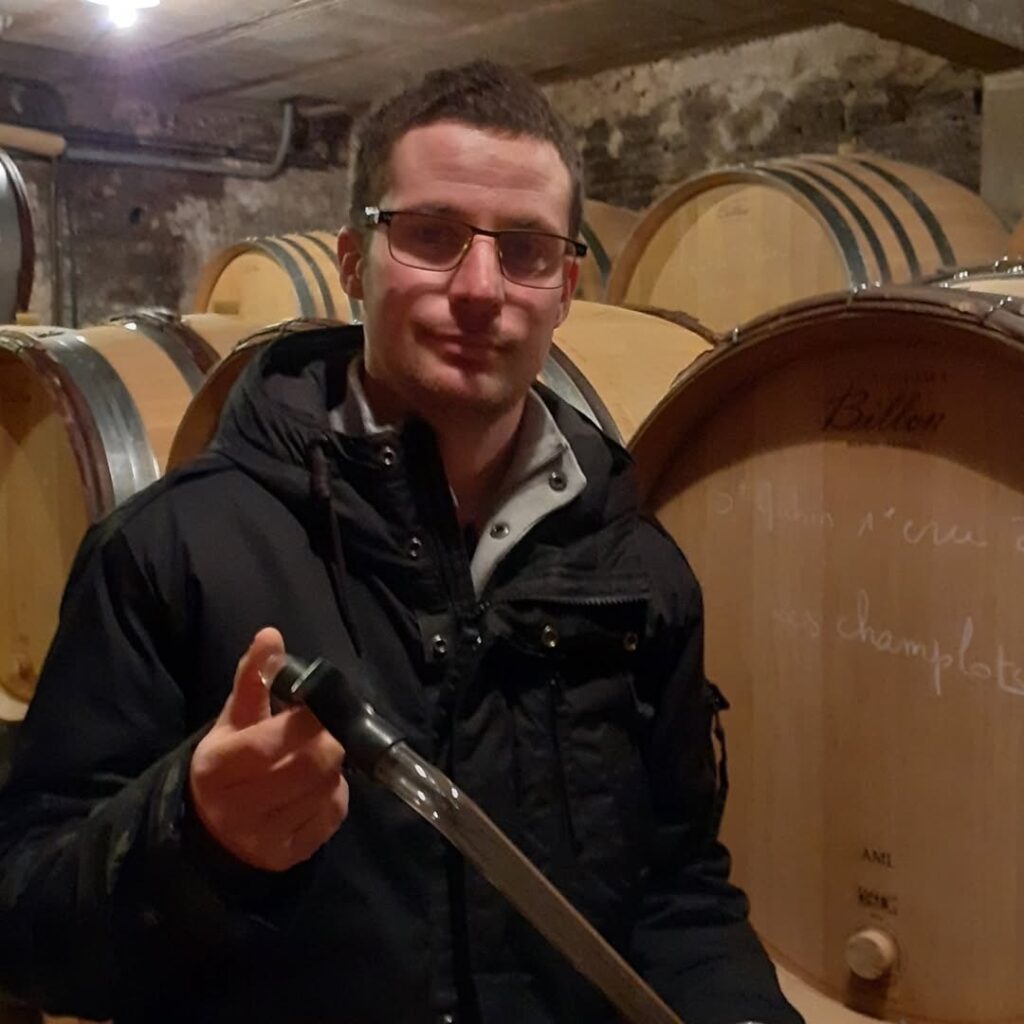
The Story of Domaine Gilles Bouton
At the center of this appellation’s modern revival is Domaine Gilles Bouton, located in the quiet hamlet of Gamay. Gilles Bouton took the reins of his maternal grandfather’s modest 4-hectare (9.6-acre) estate back in 1977. Through decades of hard work and an unyielding dedication to quality, the family holding has grown to total 15 hectares (36 acres). Today, their prime vineyard parcels are spread out over four famous villages: Saint-Aubin, Chassagne-Montrachet, Puligny-Montrachet, and Meursault. This represents prime property entirely situated within the legendary “Golden Triangle” of white Burgundy.
Gilles was proudly joined by his son, Julien, at the end of 2008. Together, this father-son duo represents the true spirit of the Côte de Beaune grower: deeply connected to the dirt, fiercely independent, and dedicated to capturing the exact signature of each individual plot. The domain today remains small and highly focused, producing an average of just 60,000 bottles per year. Because they prefer personal connections, the Boutons sell the vast majority of their wine directly to private individuals, either out-the-door at the domain or at numerous wine salons across France and of course to us at burgundywine.com.
Principles in the Vineyard and Cellar
The Bouton philosophy centers tightly on the concept of lutte raisonnée, an agricultural approach translated as “the reasoned struggle.” Rather than following a rigid chemical calendar or a dogmatic hands-off protocol, the Boutons choose to live in their vineyards. They pay close attention to daily soil conditions and strive to limit vine yields naturally to maximize concentration. The soils under the vine rows are systematically turned, and natural grass growth is allowed between the rows to promote soil health.
When conscientiously practiced, lutte raisonnée can be remarkably close to pure organic farming. The Boutons use chemical treatments less often and far less aggressively than conventional producers, intervening only when a crop’s health is genuinely threatened. They know that no amount of winemaking skill, technology, or special equipment can produce great wine without great fruit.
This meticulous care carries over into the cellar. For their white wines, fermentations occur naturally without the addition of cultured yeasts. The whites are raised on their fine lees for between 12 and 15 months in French oak barrels (using 20% to 30% new oak), accompanied by regular bâtonnage (stirring of the lees) to build texture and richness.
The estate’s red wines follow an equally careful path. Fermentations are natural and take place in thermo-regulated tanks with a total vatting time of 15 to 20 days. They are then raised for 15 to 18 months in 30% new French oak, allowing the tannins to soften beautifully.
Featured Selections
The following wines beautifully showcase Domaine Gilles Bouton’s finest expressions. These are wines built for the table, offering a beautiful balance of richness and refreshing cut.
- Domaine Gilles Bouton Saint-Aubin Blanc: The perfect introduction to the estate’s style. It opens with aromas of white flowers, lemon curd, and crushed chalk, leading to a vibrant, clean, and refreshing palate.
- Domaine Gilles Bouton Saint-Aubin 1er Cru “En Remilly”: A sublime white wine, sourced from one of the most famous Premier Cru vineyards in the appellation, which sits just around the corner from the Grand Cru Chevalier-Montrachet hill. This wine delivers incredible depth, a rich texture, and a long, salty, mineral-driven finish.
- Domaine Gilles Bouton Saint-Aubin 1er Cru “Champlots”: A magnificent representation of high-altitude limestone. It boasts electric energy, chiseled structure, and notes of green apple balanced by a subtle toasted brioche complexity from its time on the lees.
- Domaine Gilles Bouton Saint-Aubin Rouge “En Créot”: A wonderful reminder that Saint-Aubin produces delightful reds. This Pinot Noir is bright and crunchy, packed with tart red cherry notes and a hint of earthy spice.